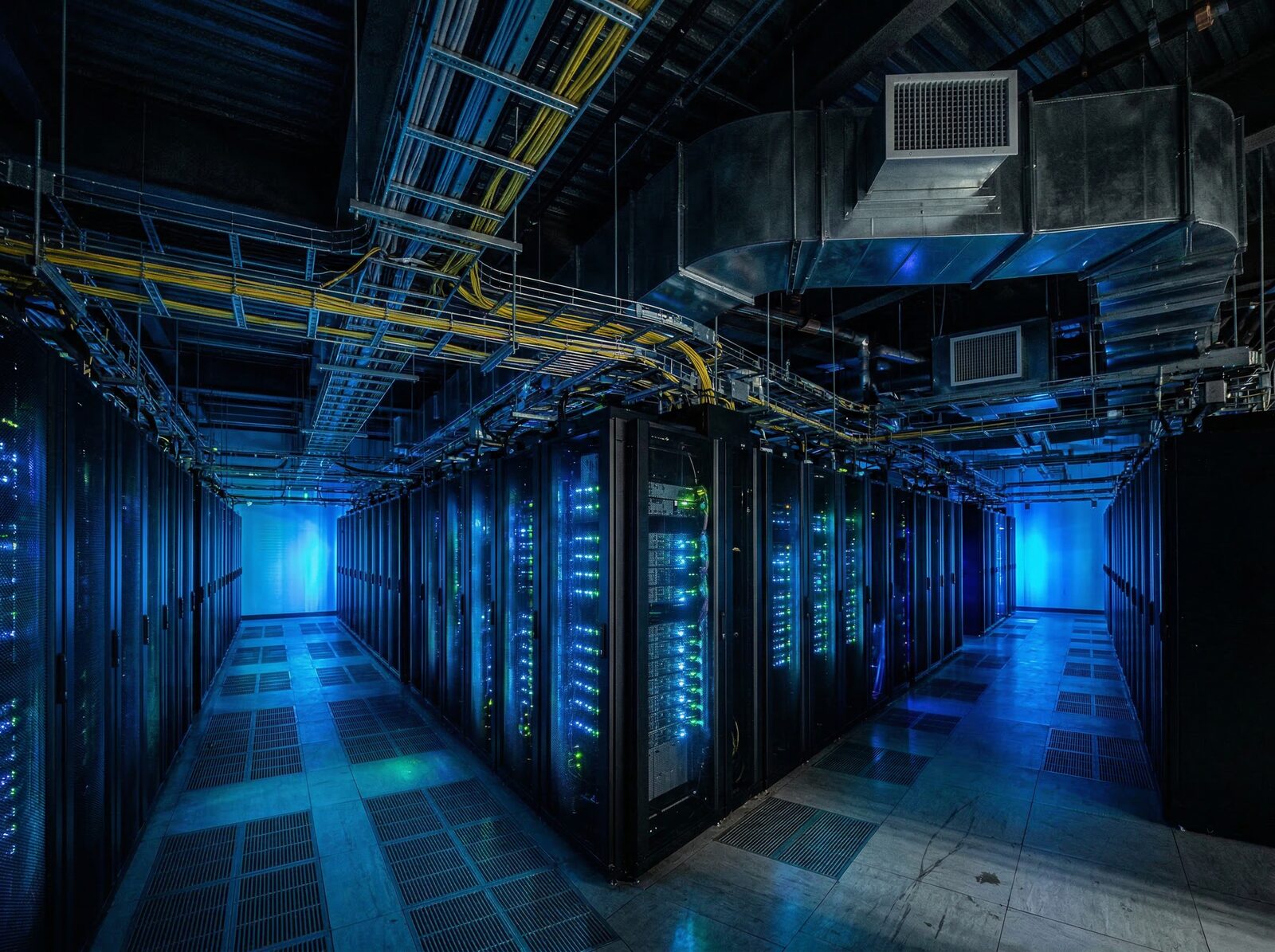
Data centers built for concurrent maintenance and PUE.
Medium-voltage electrical distribution, cable bus systems, generator plants, and cooling designs coordinated against Uptime Institute topology standards and the practical realities of an operating facility.
Redundancy is a topology decision, not a checklist.
Data center MEP design starts with the topology — N, N+1, 2N, or 2(N+1) — because that decision drives the entire electrical distribution and cooling plant. We work at the feeder-sizing level with the specifics that get skipped in less rigorous designs: fault current at the incoming service, thermal derating of the medium-voltage feeder run, and the coordination sequence that keeps the load fed during concurrent maintenance.
Every design assumption is documented and defensible: the design-basis IT load, the diversity and growth factor applied, the ambient conditions used for equipment ratings, and the coordination sequence for planned and unplanned events. Facilities operations teams inherit a set of drawings that reflects what was actually built and how it's actually intended to be operated.
Systems that carry the critical load.
Medium-voltage distribution
Utility service coordination, 15 kV and 35 kV feeder sizing with Neher-McGrath and CYMCAP thermal analysis, metal-clad switchgear specification, and cable bus vs. duct bank comparison for the incoming service.
UPS and static transfer switches
Static UPS sizing against the design-basis IT load with diversity factor documented, battery vs. flywheel selection, static transfer switch coordination, and downstream distribution to the PDUs.
Generator plants
Level 1 emergency and continuous-duty standby generators per NFPA 110, paralleling switchgear, fuel storage and day-tank design, exhaust and cooling coordination, and load bank test provisions.
Cooling and mechanical
CRAC/CRAH and chilled water plant sizing, containment (hot aisle, cold aisle, in-row) coordination, humidity control, and PUE-informed system selection. Free cooling economizer strategy where climate supports it.
Fire protection and detection
Very Early Warning fire detection (VESDA-class aspirating systems), pre-action sprinkler systems per NFPA 13, and clean agent suppression for critical electrical rooms per NFPA 2001. Coordination with the shutdown sequence.
Grounding, bonding, and EMI
Signal reference grid, isolated grounding for sensitive equipment, and coordination with the raised floor grounding scheme. Lightning protection risk assessment per NFPA 780.
Concurrent maintenance and testing
Documented sequences of operation for planned maintenance events. Integrated systems test (IST) participation and coordination with the commissioning agent from Level 1 through Level 5 testing.
The standards this sector demands.
Send us your data center scope.
Feasibility study, new construction, retrofit, or capacity expansion — send us the topology target and the design-basis IT load, and we'll respond with a clear approach and schedule.